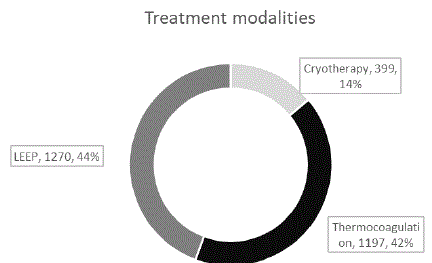
Figure 1: Treatment options offered for women with positive VIAC findings.


Vitalis Guvava1* K Masunda1 G Katsamba1 A Shamhu2
1JF Kapnek, Harvey Brown Avenue, Milton Park Harare, Zimbabwe*Corresponding author: Vitalis Guvava, Harvey Brown Avenue, Milton Park Harare, Zimbabwe, Tel: +263773495760, E-mail: [email protected]
Cervical cancer is the most common cancer in women in Zimbabwe with approximately 3,000 women being diagnosed and close to 2,000 succumbing to the malignancy annually. HIV remains one of the drivers of cervical cancer in Zimbabwe. In 2019, an estimated 20% of eligible women in Zimbabwe accessed cervical cancer screening services. In collaboration with the Ministry of Health and Child Care, JF Kapnek Zimbabwe, a local NGO, is implementing the Target, Accelerate, Sustain Quality Care for HIV epidemic control, (TASQC program) in six districts in Masvingo province. Visual Inspection with Acetic Acid (VIAC) is offered to women living with HIV targeting the 25 to 49 years age group. Services are provided daily at 20 health care facilities while 150 facilities and health posts are visited quarterly for outreach services. Between April 2022 and August 2024, a total of 86,499 VIAC screenings were done, reaching 119% of the target, which were approximately 2500 per month. Over 40% of all screenings were done at community level with districts like Zaka (62%) and Chivi (57%) doing most of their screening at community level. A total of 115,105 WLHIV were mobilized for VIAC by community volunteers. VIAC positivity at facility level was 6% while at community level was 5%. Treatment coverage of 85% was achieved with most women treated via LEEP followed by thermocoagulation. Treatment was mostly at facility level. The main challenges noted in this program were staff attrition, competing community programs and difficulties accessing some geographical areas, especially in the rainy season. Community based cervical cancer screening can be a way to scale up access to women from hard-to-reach areas. Resources need to be availed to ensure more access to vulnerable women.
Cervical cancer; Women living with HIV; Community screening; Lay cadres
Cervical cancer is the fourth most common cancer in women globally with approximately 660,000 new cases and 350,000 deaths in 2022 [1]. Most cases of cervical cancer occur in low and middleincome countries, and the burden is driven by lack of access to Human Papillomavirus (HPV) vaccination, cervical cancer screening and treatment services and other socioeconomic determinants of health.
In Zimbabwe, cervical cancer is the commonest cancer among women with approximately 3,000 new infections and 2,000 deaths annually [2]. One of the main drivers of cervical cancer burden in Zimbabwe is a high prevalence of HIV [3]. Women living with HIV are more likely to have incident HPV infection and HPV persistence [4].
The World Health Organization (WHO) recommends vaccination against HPV by the ages of 9-14 years to prevent HPV infection, cervical cancer, and other HPV-related cancers as well as screening from the age of 25 years to detect cervical disease as ways in which cervical cancer can be prevented [1]. Zimbabwe has scaled up both modalities recommended by WHO, but access remains poor with an estimated 20% of the population having access to screening services [5]. Limited financial resources, infrastructure for screening and treatment, human resources, and poor knowledge among patients all contribute to poor access to cervical cancer screening and thus delayed diagnosis and poor outcomes [6].
Previous studies have shown that integration of cervical cancer screening in HIV care and treatment programs and reducing costs associated with access to cervical cancer screening services are some of the ways in which access to cervical cancer services can be increased [7]. Community based cervical cancer screening is increasingly recognized as a cost effective and efficient way to reach to women from hard-to-reach areas with screening services and cuts costs for already disadvantaged women who may have had cost as a barrier to access to accessing services. When combined with the test and treat approach this offers same day service to treatment services as well.
The Target, Accelerate, Sustain, Quality Care for HIV epidemic control (TASQC program) is an HIV care and treatment program being implemented by the Organization for Public Health Interventions and Development (OPHID), JF Kapnek Zimbabwe and the Zimbabwe Network for People Living with HIV (ZNNP+) in 4 provinces of Zimbabwe: Bulawayo, Chitungwiza, Masvingo and Matabeleland South provinces. The program seeks to contribute to the achievement and sustainability of HIV epidemic control through the provision of technical, financial, and material resources to the Ministry of Health and Child Care (MOHCC). One key component of the program is the cervical cancer screening program which seeks to increase access to cervical cancer screening and treatment of precancerous lesions targeting women living with HIV who are between 25-49 years of age.
This paper seeks to describe the cervical cancer screening program and how it has increased access to cervical cancer screening services for women from hard-to-reach areas with a focus on Masvingo province in Zimbabwe.
JF Kapnek Zimbabwe is implementing the TASQC program in 6 of 7 districts in Masvingo Province, Zimbabwe. The six districts have a total of 180 facilities offering public health services including HIV testing, treatment, and prevention of mother-to-child services. Cervical cancer screening services are offered through two methods, Visual Inspection with Acetic Acid and Cervicography (VIAC) and HPV self-sampling with laboratory-based testing. The target age group aligns with WHO recommendations and are the women living with HIV who are 25-49 years old, but services are offered to all women irrespective of age or HIV status.
VIAC services are provided daily at 20 static sites. These are high volume sites catering for over 1,000 people living with HIV, mainly secondary level facilities, with dedicated rooms, equipment, and personnel for VIAC services. The remaining facilities, mainly low volume primary care facilities, are reached through outreach services quarterly or semi-annually depending on the number of women living with HIV that the facility supports.
Outreach services are usually offered by personnel from the secondary level facility who are supported with equipment, transport, and lunch allowances by JF Kapnek Zimbabwe. These services are offered at either the health facility or at health posts, schools, or other points within the community where women can reach. Outreach services rarely offer cervical cancer screening services only but are usually integrated with other services including delivery of AntiRetroviral Therapy (ART), viral load sample collection, HIV testing, child growth assessments and nutrition services, immunization services including delivery of HPV vaccination to eligible girls and general outpatient services.
The national cervical cancer screening program recommends HPV DNA testing as the first choice with VIAC done for those with an HPV DNA positive result. If they screen negative on VIAC annual rescreening is recommended. For those screening positive treatment at the same sitting using either cryotherapy, thermocoagulation or Loop Electrical Excision Procedure (LEEP) is recommended. In the absence of HPV DNA testing the TASQC program recommended annual screening of women living with HIV using VIAC.
A key component of the cervical cancer screening program has been community lay cadres. These are people living with HIV with basic literacy skills whose main roles include peer support, defaulter tracking, and tracing, offering health education at community level and mobilizing women for cervical cancer screening services. This mobilization is in two ways: they remind eligible women within their communities on the need to get screened for cervical cancer and inform women on proposed dates for outreach services. They are a source of community intelligence and form a bridge between the community and facility by communicating on any community events that may hinder outreach services. At facility level, these community cadres help navigate women to cervical cancer screening points ensuring no WLHIV leaves the facility without getting screened. A subset of these community cadres, who are female, has also been trained in HPV selfsampling and assist women within the community to collect samples for genetic testing.
These community lay cadres document their mobilizing efforts through an Open Data Kit (ODK) platform and all the data for cervical cancer screening is reported through the MOHCC’s health information system. The TASQC program collected weekly data on screening and treatment and disaggregated service provision by community and facility level.
Data from the ODK platform was downloaded into a Comma Separate Values (CSV) file. Unique codes were given for each activity that the community lay cadres undertook. These were coded from C1 to C13 with mobilization for cervical cancer screening being coded as C6. This helped in identifying the exact service the client was offered. To analyze the data the Power Query option was used to filter the cervical cancer screening services and remove entries for other services provided. Duplicate entries were identified and removed while male sex (erroneously coded with C6) was removed to ensure only women were included in the analysis. Data from the MOHCC’s DHIS system was also downloaded as CSV files and all the data were analyzed in Microsoft Excel.
The TASQC program is registered with the MOHCC and there is an approval for implementation research with the provincial medical directorate for Masvingo province. The data utilized in this analysis were routine aggregate de-identified data and no special ethical approval was needed.
As of December 2024, the supported six districts in Masvingo province had a total of 69,236 women living with HIV aged more than 25 years accessing ART at the public health facilities. Women within the target age group (25-49 years) were 48,654.
Between April 2022 and August 2024, when the community lay cadres were using the ODK tool, a total of 115,105 women were mobilized for VIAC services by community cadres. During the same period, a total of 86,499 VIAC screenings were done among women living with HIV. Of these 60,917 were among women in the 25-49-year age group. The number of women screened did not vary significantly by year but there was a noticeable decrease in the proportion of women who were being screened for the first time from 40% in 2022 to 32% in 2023 and then 25% in 2024 showing that more women being screened were women who had been reached previously (as per the annual screening algorithm).
Approximately 40% of all screenings were done at community level with significant variation among districts as shown in table 1.
| District | Facility screened | Community screened | % screened at facility level | % screened at community level |
| Chiredzi | 14251 | 5354 | 73% | 27% |
| Chivi | 3553 | 5041 | 41% | 59% |
| Gutu | 10206 | 4554 | 69% | 31% |
| Masvingo | 11407 | 10771 | 51% | 49% |
| Mwenezi | 8525 | 2186 | 80% | 20% |
| Zaka | 4017 | 6633 | 38% | 62% |
| Masvingo Province | 51960 | 34539 | 60% | 40% |
Table 1: Proportion of VIAC screening done at community level.
The differences in proportion of screenings done at community level relate to differences in district geography, total number of women living with HIV and number of static sites available within each district with a general tendency towards more facility screening in those districts with a higher number of static sites and vice versa.
The overall positivity noted was 6% at facility level and 5% at community level. District level differences in positivity are shown in table 2.
| District | Facility positives (%) | Community positivity |
| Chiredzi | 653 (5%) | 223 (4%) |
| Chivi | 257 (7%) | 317 (6%) |
| Gutu | 428 (4%) | 182 (4%) |
| Masvingo | 861 (8%) | 622 (6%) |
| Mwenezi | 462 (5%) | 123 (6%) |
| Zaka | 370 (9%) | 311 (5%) |
| Masvingo Province | 3032 (6%) | 1778 (5%) |
Table 2: Differences in positivity by place of screening.
Generally, the proportion of women testing VIAC positive was higher at facility level compared to community level. However, quality assurance in screening was done through regular meetings with a specialist gynecologist and experienced VIAC nurses where teams would discuss the quality of pictures and the diagnoses made in a bid to ensure continuous mentorship and continuous quality improvement. Through these meetings continuous quality improvement was ensured.
The province managed to reach treatment coverage of 85% with three main treatment modalities offered as shown in figure 1.
Figure 1: Treatment options offered for women with positive VIAC findings.
Most of the clients were treated using the test and treat approach while 44% had to be treated using Loop Electrosurgical Excision Procedure (LEEP), which was offered once every quarter as LEEP camps are held at secondary level facilities with patients being offered transport to reduce costs associated with accessing treatment services.
Patients with findings suggestive of cervical cancer and those with LEEP biopsy samples showing invasive lesions were referred for further management at public health facilities by specialists.
Since 2023 the program has also started distributing HPV selfsampling kits. By December 2024, a total of 4,926 kits had been distributed and 21% of these had been distributed at community level. However, only 46% of results had been returned showcasing challenges with testing at the laboratory including stock ruptures of consumables for testing and human resources challenges.
The program was not without its challenges. The 2022-2024 periods was the period when the world was “reopening” after the COVID-19 pandemic and there was an out flux of qualified nurses leaving the country going to seek greener pastures. These also included personnel trained in offering VIAC services and the program had to invest resources into training more personnel which added costs.
Service provision at community level was also affected by geographical access. In the rainy season especially, some areas, difficult to reach under normal conditions, become impassable meaning outreaches have to be cancelled or rescheduled (Figure 2).
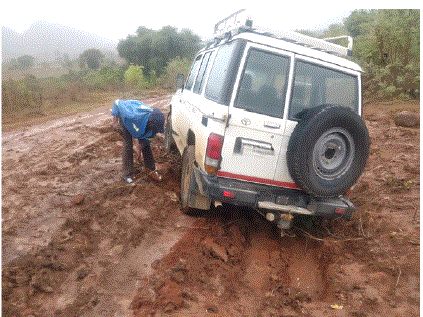
Figure 2: A driver trying to rescue his vehicle stuck in the mud while travelling for community activities in Zaka district.
Impromptu, unforeseen, and unplanned for community events like funerals, food-for-work programs or other community-based programs also affect community based cervical cancer screening. Turnout can be poor, and the community lay cadres played a significant role in offering “community intelligence” and advising the rescheduling of outreach services once they were aware of other community programs.
Outreach services by nature are more expensive to offer and because of a finite amount of resources there had to be a limit to the number of outreaches offered. This would mean some women are missed for VIAC services and usually these are the women most at need.
Community based cervical cancer screening in Masvingo managed to increase access to cervical cancer screening for women living with HIV with approximately 40% of all women screened being screened at the community level. Treatment services were also offered in a test and treat approach with 56% of all treatment done using cryotherapy and thermocoagulation.
This approach has also been utilized in other settings. In Malawi community-based screening was shown to increase access to VIAC services with 89% of eligible women offered screening managing to access services and 93% of women eligible for thermal ablation being treated at the same sitting [8]. Reducing transport cost, a wellrecognized barrier to accessing services, may have helped increase access to cervical cancer screening in this setting. Accessibility of services has been seen as the greatest facilitator to screening services [9]. Increasing the number of screening sites and the number of HCWs trained in cervical cancer screening is one way of increasing accessibility. By offering services within the community and offering outreach services the TASQC program has managed to increase accessibility to cervical cancer screening services.
In the TASQC program community lay cadres’ roles included providing health education, reminding women to get screened for cervical cancer and communicating dates for outreach services to eligible women. In other settings, community health workers have played a role in community education, raising awareness, conducting, and assisting in cervical cancer screening [10].
The provision of education through awareness campaigns is recognized as a facilitator to screening services [8,11-14]. Face to face education has been seen to be particularly effective in increasing acceptability of cervical cancer screening services [12]. The TASQC program’s utilization of community cadres for knowledge awareness helped in offering education and may also have tackled another known facilitator which is community involvement since these lay cadres are women from the communities in which they offer services.
Approximately 5% of all women screened at community level were VIAC positive. Gabaza, et al reported a VIAC positivity of 6.5% but this was predominantly facility-based screening [12]. In other community based cervical cancer screening services a similar positivity to the TASQC program was noted, and community-based treatment has also been shown to be safe with minimal side effects seen in women screened and treated at community level [8]. It has been noted previously that the use of the test and treat approach leads to a high treatment coverage when compared to screening services that refer women to other settings for treatment [12] and the TASQC program achieved a high treatment coverage because of this approach. The differences between facility and community positivity need to be investigated further.
The TASQC program has only recently started offering HPV self-sampling and the service is offered at community level as well. However, findings from other settings show that women may prefer female health care worker led supervision and self-sampling at health facilities [11]. Future research will be needed to examine the acceptance of community-based HPV self-sampling in Masvingo province.
Community-based cervical cancer screening can bridge the access barrier for women living in hard-to-reach areas. Community lay cadres can be an invaluable component of community based cervical cancer screening by offering health education, reminding women of the need to get screened, and communicating dates for outreach services.
• Funding needs to be increased to support cervical cancer screening services, especially in already disadvantaged and hardto-reach areas.
• HPV DNA self-sampling and testing needs to be scaled up especially at community level since it has the potential to reach more women.
The TASQC program is made possible by the generosity of the American people through the State Department. The authors would also like to thank all the frontline health workers who offer cervical cancer screening services to women living with HIV.
We have no conflicts of interest.
Download Provisional PDF Here
Article Type: RESEARCH ARTICLE
Citation: Guvava V, Masunda K, Katsamba G, Shamhu A (2025) Community Based Cervical Cancer Screening Bridging the Access Gap for Women from Hard-To-Reach Areas: The Case of Masvingo Province, Zimbabwe. J HIV AIDS 10(1): dx.doi.org/10.16966/2380-5536.198
Copyright: ©2025 Guvava V, et al. This is an open-access article distributed under the terms of the Creative Commons Attribution License, which permits unrestricted use, distribution, and reproduction in any medium, provided the original author and source are credited.
Publication history:
All Sci Forschen Journals are Open Access