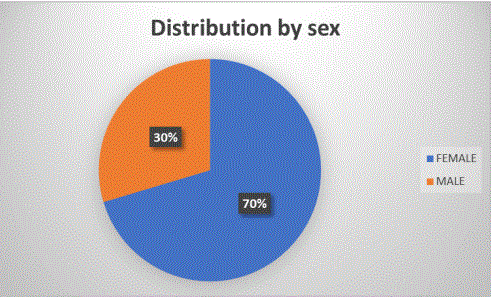
Figure 1: Distribution by sex.

Romny Infante*
Social Security and Welfare Institute of the Ministry of Education, Maracay, Aragua State, Venezuela*Corresponding author: Romny Infante, Social Security and Welfare Institute of the Ministry of Education, Maracay, Aragua State, Venezuela; Tel: +584125881497; E-mail: [email protected]
The relationship between self-esteem and self-concept with job performance has been analyzed by several authors to a relatively significant, if not insufficient, extent. In the case of Venezuela, there are no substantial studies on this topic, especially considering that the country underwent a process of failed healthcare reforms in the last two decades. During this experience, a significant number of people were incorporated into the system, perhaps without adequate selection or the necessary training for such important tasks as those demanded by the healthcare sector. This prompted an analysis of one of the sector's most visible shortcomings: the lack of compassion in patient care. To address this issue, an exploratory quantitative study was designed, consisting of informational sessions for workers on self-esteem and self-concept. Following these sessions, a survey with six closed-ended questions was administered to gather the participants' opinions. Analysis of the collected data revealed that workers predominantly expressed feelings of fear and insecurity when performing their work. According to other responses, this was associated with limitations in their professional skills. Therefore, the study highlights the need to establish permanent psychological support and professional development programs for healthcare personnel in their various areas.
Professionalism; Quality; Warmth; Self-evaluation; Health
Over the past 20 years, a restructuring of the health system in Venezuela has been attempted, beginning with adjustments to the legal framework, as shown in Article 83 of the Constitution of the Bolivarian Republic of Venezuela [1], and the implementation of the Barrio Adentro plan, which aimed to bring healthcare to the most vulnerable sectors of the population. The planning included the training of professionals in different areas of the system-medicine, nursing, bioanalysis, among others-leading to the mass inclusion of people who began practicing within a short period of time [2].
When analyzing the results of the first two decades of this process, a profound crisis in care becomes evident, not only due to a lack of material resources and deteriorating infrastructure, but fundamentally due to the inadequate attitude of healthcare personnel in carrying out their work [3]. What could be the reasons for these difficulties? Are the healthcare personnel adequately trained to perform their duties? Can the inadequate warmth of patient care be attributed to the socioeconomic crisis the country is experiencing, from which healthcare workers are not exempt? Has there been a lack of effective psychological screening of many of the people who are currently part of the system? [4,5]
This last question highlights the need to analyze the psychoemotional component of healthcare personnel. The importance of self-esteem and self-concept are crucial in determining the ethical attitude of human beings when performing their work [6,7].
Self-esteem is the positive or negative value, perception, or judgment that a person makes of themselves based on the evaluation of their thoughts, feelings, and experiences. Self-esteem is, therefore, the subjective or affective (emotional) consideration of ourselves [8].
The degree of positive or negative thoughts we have about ourselves will be a determining factor in how we express ourselves and make decisions; it also affects physical appearance, knowledge, attitudes, beliefs, and skills.
Self-concept is defined as the set of opinions, based on objective elements, cognitions, feelings, and evaluations, that a person holds about themselves; it can be said that it is the knowledge one has of oneself [9].
Self-concept is how an individual defines themselves: what do they know about themselves? What role do they play in the world? What is their social identity? In other words, what is their place in society? What is their body image? And personal identity: Who are they? [10,11].
Sabanciogullari S, et al. define self-concept in the professional context as the perception one has of oneself as a member of a profession. The professional recognizes their own role and specific responsibilities, and also internalizes the philosophical principles, beliefs, knowledge, and attitudes of their occupation [12].
Taking into account the above and seeking answers to the questions initially raised, this research is carried out by requesting the opinion of personnel from different health institutions; to determine the level of knowledge they have about these concepts and how they may influence their work performance, in order to propose analysis schemes and strategies for addressing them [13].
The availability of research on this topic globally is limited; while numerous studies can be found in the workplace and corporate sectors, primarily in business, commercial, or entrepreneurial environments, there is a substantial lack of research in the public sector, particularly within healthcare systems, beyond the work carried out by nursing groups in Ecuador and Turkey, cited in this study. Hence the relevance of investigations such as the one we have undertaken here.
A quantitative exploratory study was conducted with a nonprobability sample of 54 employees from three state institutions with a focus on the health sector: the Institute of Social Security and Assistance of the Ministry of Education (IPASME) at its Maracay Medical Care Unit in Aragua State, where 22 people agreed to participate in the surveys out of a total of 440 employees (5%); the National Institute of Nutrition, Aragua branch, where 18 employees participated (75% of its staff); and the Aragua State Institute of Senology (ISENA), where 14 employees completed the survey out of a total of 178 employees (14.28%). The study was conducted between January and December 2025. Selection was based on the following inclusion criteria:
1. Employees with permanent or contracted employment.
2. Employees with more than one year of service at these institutions.
3. From all areas of care, professions, or occupations within the institutions.
4. Who attended the theoretical activity on the topic, which was given at each location, prior to the application of the surveys.
1. Failure to attend the theoretical activity.
2. Less than twelve (12) months of employment at your institution.
3. Lack of complete freedom to participate in the survey
A theoretical-practical activity was conducted, presenting information on self-esteem and self-concept. This activity was led by a licensed psychologist, hired for this purpose, and consisted of a 45-minute PowerPoint presentation. Authorization was obtained from the administration of each institution, as the activity took place during working hours, in the morning, and at the official headquarters of each center. Following the information session, participants completed written and oral exercises related to the presented material. At the end, surveys were distributed to those who agreed to participate. The survey included fields for age, sex, length of employment, and six closed-ended questions. The information was processed using an Excel database, and the data were tabulated and graphed according to the variables: age, sex, and the responses to the six survey questions.
From an ethical standpoint, the criteria of the Declaration of Helsinki of 2000 were considered. All workers were informed of the objective of the research and their right to remain anonymous, to voluntarily agree to participate in the study, and to withdraw when they deemed it necessary. This guidance was provided during the informational (theoretical-practical) activity conducted prior to the application of the surveys [13].
Of the 54 workers surveyed, 70% (n=38) were female and 30% (n=16) were male. The largest age group was between 31 and 40 years old; 33.3% (n=18). The mean age among the 54 participants was 40.76 ± 20.24 years.
Regarding the question about the value that best identifies them, 37.03% (n=20) mentioned honesty; 24.07% (n=13) indicated perseverance; 22.22% (n=12) stated empathy; and 16.66% (n=9) leaned toward loyalty as the value that best identifies them. For the question about the emotions that difficult situations generate, 18.5% (n=10) mentioned that difficulties generate insecurity. 22.22% (12) tend to feel guilty for the mistakes they may have made; 46.29% (n=25) report that they have difficulty controlling frustration or anger and 12.96% (n=7) have feelings of inferiority.
When asked about their perceived internal obstacles, 33.33% (n=18) indicated difficulty managing uncertainty or change; 25.92% (n=14) believe their abilities are limited; 22.22% (n=12) fear failure or rejection; and 18.5% (n=10) believe their biggest personal obstacle is a lack of motivation or discipline.
Regarding self-definition, 42.59% (n=23) consider themselves independent and self-sufficient; 33.33% (n=18) perceive themselves as kind and understanding; 16.66% (n=9) define themselves as leaders and successful individuals; and only 7.4% (n=4) see themselves as intelligent and creative.
Regarding how they rate their emotional connection to their work, 51.85% (n=28) feel very connected and passionate about what they do; 27.77% (n=15) of respondents feel connected, but work is not very relevant in their lives; 14.81% (n=8) do not feel emotionally connected to their work; and 5.5% (n=3) feel frustrated with their work. When asked what they hope to gain from their work, 29.62% (n=16) hope their work will have a positive impact within the institution; 25.92% (n=14) expect a salary increase or additional financial benefits; 24.07% (n=13) wish for the opportunity to assume greater responsibilities within the institution; and 20.37% (n=11) would like to receive recognition for their work (Figure 1, Table 1, Figures 2-6).
Figure 1: Distribution by sex.
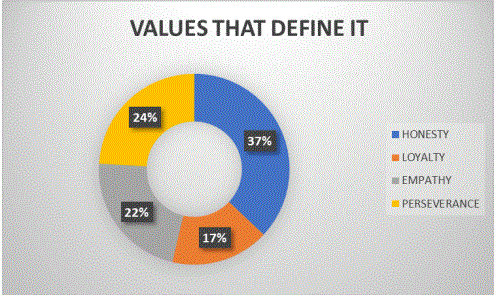
Figure 2: Values that define it.
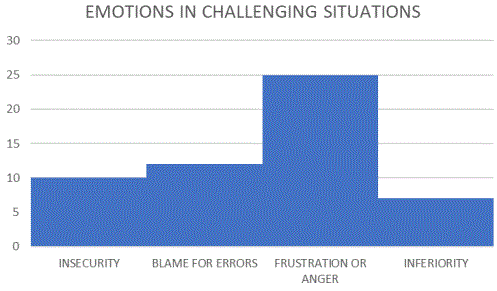
Figure 3: Emotions in challenging situations.
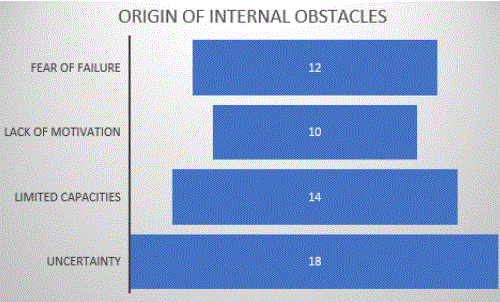
Figure 4: Origin of internal obstacles.
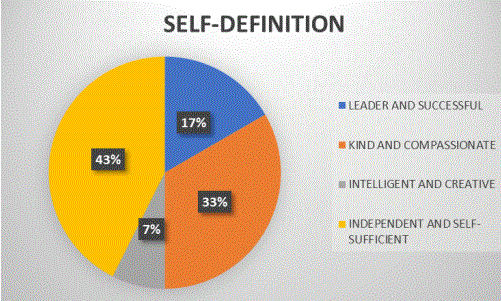
Figure 5: Self-Definition.
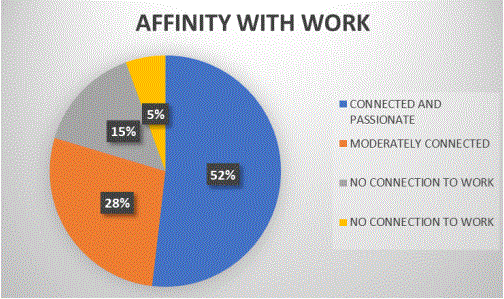
Figure 6: Affinity with work.
| AGE GROUP | Nº OF PEOPLE | PERCENTAGE% |
| 20-30 | 10 | 18.51% |
| 31-40 | 18 | 33.35% |
| 41-50 | 15 | 27.78% |
| 51-60 | 10 | 18.51% |
| ≥ 61 | 01 | 1.85% |
| TOTAL | 54 | 100% |
Works such as that of Joice Franco and colleagues, “Professional Self-Concept of the Ecuadorian Nurse: An Inward Look,” highlight the importance of self-esteem and self-concept in the professional development and performance of nurses, which is applicable to any type of professional activity, since these are aspects common to all human beings [14]. In our work, we explored feelings such as fear, confidence, and security, and values such as loyalty, honesty, perseverance, and altruism, as determining factors in the attitude that workers display when performing their activities. This becomes even more relevant when the service provided is healthcare, where the greatest possible accuracy, promptness, and agility are required, since human life is at stake, and for this same reason, these actions must be carried out with compassion and solidarity [15,16].
Sabanciogullari S, et al. [12] explain how professional self-concept guides employee performance because it reflects what the employee considers to be their capabilities [17]. In our research, we see that most respondents’ express values such as honesty and empathy, approximately 40% and 20% respectively; however, they reflect feelings of fear and insecurity when performing their work in 80% of cases. When evaluating their personal capabilities, nearly 80% admit to having limitations, that is, they believe they do not have sufficient skills to perform their tasks. This research also demonstrates that respondents have a deeply affective nature, and therefore, when expressing their desires, 70% are guided by aspects such as personal recognition and appreciation of their work. This corresponds with findings from research such as Llontop's, which shows the importance of professional recognition as an incentive for good job performance [18].
This raises questions about the origin and how to address these situations. Is family upbringing the determining factor in self-esteem and self-concept? Can academic development influence and shape the internal content of a professional? Should permanent programs be established in academic centers and healthcare institutions for the psychological support of students and workers? These are all questions that could be explored and addressed in further research [19,20].
Although the number of participants in the study is small, considering the universe of workers in all health care institutions in the Venezuelan state; which is close to four hundred thousand (400,000) members and that the geographical scope of the study was also a limitation, since information was only collected from the staff of a single state (the state of Aragua) and that at that time there was still some caution in the population when giving an opinion about their work feelings, this research does not fail to represent a point of reference to continue the exploration of this issue on a larger scale.
The study showed the influence of self-esteem and self-concept on the work performance of health personnel in Venezuela. The conviction of not having the appropriate skills to perform their work determines an inadequate disposition and empathy when carrying out their duties, which corresponds to studies in other professional environments [21-25] and opens the way for broader research on the subject.
Download Provisional PDF Here
Article Type: RESEARCH ARTICLE
Citation: Infante R (2026) Self-Esteem and Self-Concept as Determinants in the Ethics Shown by Venezuelan Health Personnel. J Epidemiol Public Health Rev 8(1): dx.doi.org/10.16966/2471-8211.229
Copyright: © 2026 Infante R. This is an open-access article distributed under the terms of the Creative Commons Attribution License, which permits unrestricted use, distribution, and reproduction in any medium, provided the original author and source are credited.
Publication history:
All Sci Forschen Journals are Open Access