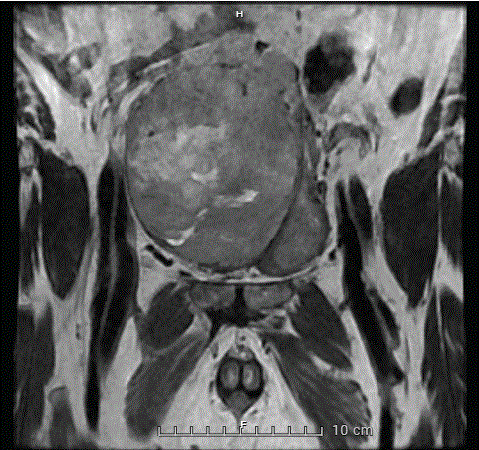
Figure 1: Abdominal magnetic resonance imaging: mass in the pelvic region, with a hypodense, necrotic-appearing center, measuring 209 × 103 mm, with no fat plane separating it from the bladder, which was displaced.


María Jimena Soutelo* Valentina Sabaté Bianca García Gabriel Faraj
Service of Endocrinology, Churruca Visca Hospital, Buenos Aires, Argentina*Corresponding author: María Jimena Soutelo, Service of Endocrinology, Churruca Visca Hospital, Buenos Aires, Argentina; E-mail: mjimenaosutelo@ gmail.com
Doege-Potter syndrome (DPS) is a rare paraneoplastic manifestation of solitary fibrous tumors (SFT), characterized by hypoglycemia secondary to tumoral production of IGF-2. We report the case of a 72-year-old man with a high-risk pelvic SFT (Demicco classification) who developed pulmonary metastases and episodes of hypoinsulinemic hypoglycemia, with concomitant suppression of GH, IGF-1, and IGFBP-3, consistent with non-islet cell tumor hypoglycemia (NICTH). Despite treatment with progressively increasing dextrose infusion rates, the patient died of respiratory failure secondary to tumor progression. Doege-Potter syndrome requires a high index of diagnostic suspicion; early recognition and multidisciplinary management are key to the metabolic and oncologic control of these patients.
Solitary fibrous tumor; Doege-Potter syndrome; Paraneoplastic hypoglycemia; NICTH; IGF-2
The association between SFT and hypoglycemia was first described by Doege and Potter in 1930 [1]. One year earlier, Nadler had reported an association between hypoglycemia and hepatocellular carcinoma, contributing to some of the earliest reports of hypoglycemia associated with non-pancreatic tumors [2]. These findings gave rise to the concept of NICTH, an infrequent entity characterized by hypoglycemia associated with neoplasms not derived from pancreatic β-cells. NICTH has been associated with a wide variety of neoplasms of epithelial, vascular, and mesenchymal origin [3].
A 72-year-old male patient was admitted in July 2025 to the Emergency Department with a one-month history of abdominal pain. Physical examination revealed an indurated mass occupying the right iliac fossa and hypogastric region. Abdominal magnetic resonance imaging showed a large pelvic mass measuring 209 × 103 mm, with a hypodense, necrotic-appearing center and no fat plane separating it from the bladder, which was displaced (Figure 1). In September 2025 an exploratory laparoscopy with biopsy was performed; pathology was consistent with SFT (Table 1). Surgical resection was attempted, revealing involvement of the bowel loops, bladder, and iliac vessels, confirming the diagnosis of SFT. According to the Demicco, et al. risk stratification model [4], the tumor was classified as a high-risk SFT (Table 2). During follow-up, the patient experienced multiple hemodynamic and infectious complications. After a cavitary and organizing pneumonia was identified on CT, thoracoscopy was performed, requiring atypical pulmonary segmentectomy due to intraoperative identification of firm-elastic consistent lesions. Pathological examination showed pulmonary parenchyma infiltrated by an atypical spindle-cell proliferation, consistent with SFT metastasis. On June 13, 2026, during hospitalization, the patient was alert and oriented to time and place, tolerating oral feeding well, when he developed an episode of disorientation associated with capillary hypoglycemia of 49 mg/dL, confirmed by a plasma glucose level of 39 mg/dL. Renal and hepatic function were normal; hypokalemia was noted. Symptoms resolved after administration of 10% dextrose. Given the suspicion of non-islet cell tumor hypoglycemia (NICTH), biochemical evaluation was performed during the episode, showing low levels of insulin, growth hormone (GH), insulin-like growth factor 1 (IGF-1), and IGF-binding protein 3 (IGFBP-3), with baseline cortisol within normal limits (Table 3). Due to persistent hypoglycemia, the intravenous dextrose concentration had to be increased to 25%, achieving normoglycemia. On July 13, 2026, the patient developed respiratory failure and died. Based on the clinical, biochemical, and imaging findings, a diagnosis of DPS secondary to a high-risk SFT with pulmonary metastasis, associated with NICTH, was established.
Figure 1: Abdominal magnetic resonance imaging: mass in the pelvic region, with a hypodense, necrotic-appearing center, measuring 209 × 103 mm, with no fat plane separating it from the bladder, which was displaced.
| Microscopic description | Histological sections show disaggregated fragments of an atypical neoplastic proliferation composed of spindle cells with indistinct cytoplasmic borders and oval nuclei with blunt edges, with occasional conspicuous nucleoli, arranged in interlacing, poorly defined fascicles. Numerous mitotic figures are identified (18 mitoses per 2 mm²). No necrosis is identified in the sections examined. |
| Immunohistochemistry | STAT6: positive, strong and diffuse CD34: positive, strong and diffuse Vimentin: positive Smooth muscle actin: negative Desmin: negative Ki-67: approximately 15% |
| Diagnosis | Consistent with solitary fibrous tumor. |
Table 1: Histology and immunohistochemistry of biopsy and surgical resection specimens.
| Parameter | Finding | Score | Patient result | |
| Age | < 55 years | 0 | ||
| ≥ 55 years | 1 | 72 years | ||
| Tumor size (cm) | < 5 | 0 | ||
| 5 to < 10 | 1 | |||
| 10 to < 15 | 2 | |||
| ≥ 15 | 3 | 19.5 cm | ||
| Mitotic count (/10 HPF) | 0 | 0 | ||
| 1-3 | 1 | |||
| ≥ 4 | 2 | More than 4 mitosis per 10 HPF |
||
| Tumor necrosis | < 10 % | 0 | Less than 10 % | |
| ≥ 10 % | 1 | |||
| Total score | 6 | |||
| Risk category | Total score | |||
| Low | 0-3 | |||
| Intermediate | 4-5 | |||
| High | 6-7 | |||
Table 2: Risk assessment and stratification of solitary fibrous tumor according to Demicco, et al. [4].
| Test | Result | Reference range |
| Glucose | 45 mg/dL | 70-100 mg/dL |
| Insulin | 0.3 mU/L | 2-25 mU/L |
| Cortisol | 13.1 µg/dL | 5-25 µg/dL |
| Growth hormone (GH) | 0.65 ng/mL | Up to 5 ng/dL |
| IGF-1 | 21 ng/mL | 21-200 ng/mL |
| IGFBP-3 | 0.3 µg/mL | 2.72-5.56 µg/mL |
Table 3: Biochemical and hormonal results.
SFT are rare mesenchymal neoplasms, with an estimated incidence of 2.8 cases per 100,000 population [5], accounting for approximately 3.7% of soft tissue sarcomas. They can arise in any anatomical region, although they predominate in the pleura, retroperitoneum, and abdominal cavity [6,7]. Between 5 % and 10.4 % of SFTs may be associated with DPS, a paraneoplastic manifestation characterized by hypoglycemia secondary to tumoral production of IGF-2, particularly its high-molecular-weight form (“big IGF-2”) [8]. Metastatic behavior has been reported in approximately 10-15 % of SFTs [6]. One of the main systematic reviews evaluating the clinical characteristics of patients with DPS [7] found no statistically significant differences in age, sex, or tumor size between those with benign and malignant tumors. However, hypoglycemia was more frequent in patients with larger tumors, particularly when the diameter exceeded 10 cm. Male patients also showed a higher frequency of hypoglycemia, although this difference did not reach statistical significance. These findings highlight the importance of considering DPS in the presence of hypoglycemia in patients with SFT, particularly in those with large tumors.
NICTH is a rare paraneoplastic syndrome, with an estimated incidence of 1 case per million person-years [9]. Its main mechanism relates to tumoral production of a high-molecular-weight, partially processed form of IGF-2 (“big IGF-2”), which acts on the insulin receptor and, to a lesser extent, on the IGF-1 receptor. Under physiological conditions, approximately 80% of IGF-2 circulates forming a ternary complex with IGFBP-3 and the acid-labile subunit (ALS), of approximately 150 kDa, which limits its passage into the extravascular space; the remainder circulates predominantly in smaller binary complexes with greater tissue diffusion capacity. In NICTH, GH suppression decreases hepatic ALS synthesis, while altered IGF-2 processing and increased IGFBP-3 proteolysis favor a higher proportion of binary complexes and increased peripheral bioavailability of IGF-2 [10,11]. As a result, peripheral uptake of glucose and potassium increases and hepatic glucose production is inhibited, while suppression of GH, IGF-1, and IGFBP-3 contributes to the characteristic biochemical profile of this syndrome [9,10].
Other, less common mechanisms of tumor-associated hypoglycemia have been described, including ectopic insulin production, hepatic or adrenal tumor infiltration, and the presence of antibodies against insulin or its receptor [10]. Mesenchymal tumors, particularly SFTs, constitute one of the most widely recognized causes of NICTH, followed by certain epithelial neoplasms, hepatic tumors, and other mesenchymal tumors. Hypoglycemia may be the initial manifestation of the neoplasm, and neuroglycopenic manifestations, such as confusion and loss of consciousness, are common [9]. The diagnosis of NICTH should be considered in documented hypoglycemia that fulfills Whipple’s triad, particularly when a hypoinsulinemic pattern is evident. During the hypoglycemic episode, suppressed concentrations of insulin, C-peptide, and proinsulin are expected, along with low levels of IGF-1, GH, and IGFBP-3, in the absence of hepatic, renal, or adrenal insufficiency that would explain the metabolic disturbance. An IGF2/IGF-1 ratio >10 is a classic supportive diagnostic finding [8,10,11]; however, a lower ratio does not exclude NICTH. Measurement of IGF2 also has limitations, as serum concentrations may be normal or low, and available assays do not routinely allow determination of the highmolecular-weight form (“big IGF-2”) [9]. In the present case, although IGF-2 measurement was not available, the diagnosis of NICTH was supported by the presence of hypoinsulinemic hypoglycemia, with concomitant suppression of IGF-1, GH, and IGFBP-3, in the setting of a high-risk SFT with pulmonary metastasis. The coexistence of hypoglycemia and a large, metastatic SFT constitutes a clinical picture highly suggestive of DPS.
Definitive treatment of NICTH is complete surgical resection of the tumor, when feasible, resulting in resolution of hypoglycemia in most cases. When resection is not possible or is incomplete, treatment is aimed at controlling hypoglycemia. Glucocorticoids are among the most widely used options due to their availability, low cost, and effect on glucose metabolism: they decrease peripheral glucose utilization and promote hepatic gluconeogenesis. They can also reduce tumoral IGF-2 production. Recombinant human growth hormone (rhGH) may be used as an alternative or in combination with glucocorticoids, as it increases IGFBP-3 and ALS synthesis and promotes ternary complex formation, thereby reducing peripheral IGF-2 bioavailability. Other strategies, such as diazoxide and somatostatin analogs, including octreotide and pasireotide, have been used with variable results, mainly based on case reports. Intravenous dextrose is primarily a supportive measure for the acute management of hypoglycemia, whereas therapies targeting the underlying IGF-2-mediated mechanism remain experimental [11].
In our patient, the inability to achieve complete resection of the SFT, together with pulmonary metastatic disease, led to persistent tumoral IGF-2 production and, consequently, persistent hypoglycemia. The progressive need for increasingly concentrated dextrose solutions to maintain normoglycemia reflects the severity and persistence of the metabolic disturbance. The unfavorable outcome, with death due to respiratory failure, was determined by the rapid progression of the tumoral disease.
DPS is a rare entity that requires a high index of suspicion for early diagnosis. A multidisciplinary approach is essential for timely recognition, control of hypoglycemia, and comprehensive management of the tumoral disease.
Download Provisional PDF Here
Article Type: CASE REPORT
Citation: Soutelo MJ, Sabaté V, García B, Faraj G (2026) Solitary Fibrous Tumor and Severe Hypoglycemia: A Fatal Presentation of Doege-Potter Syndrome. J Clin Case Stu 11(3): dx.doi.org/10.16966/2471-4925.296
Copyright: © 2026 Soutelo MJ, et al. This is an open-access article distributed under the terms of the Creative Commons Attribution License, which permits unrestricted use, distribution, and reproduction in any medium, provided the original author and source are credited.
Publication history:
All Sci Forschen Journals are Open Access