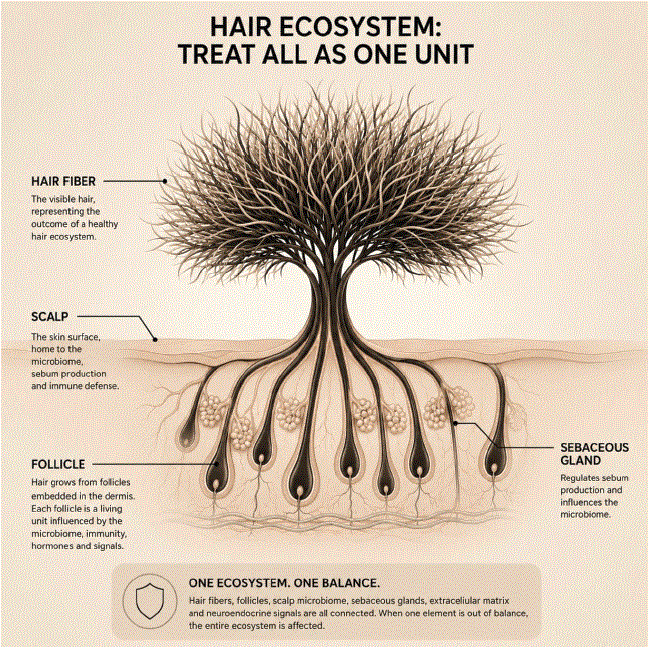
Figure 1: Hair Ecosystem: Treat all as one unit.


Patricia Fabrini1* Pedro Fabrini2 Natalia Centrone2 Marcos Vinícius Digigov Santana2 Beatriz Digigov Santana Rondon3
1Dermatologist MD Graduated in Medicine, University of Minas Gerais, Member of the medical staff at Hospital Israelita Albert Einstein, Brazil*Corresponding author: Patricia Fabrini, Dermatologist MD Graduated in Medicine, University of Minas Gerais, Member of the Medical Staff at Hospital Israelita Albert Einstein, Brazil, Phone: +5531984775497; E-mail: [email protected]
Androgenetic alopecia is highly prevalent worldwide. It is characterized by hair follicle miniaturization, leading to progressive thinning of the hair shafts that can be observed macroscopically. Androgenetic alopecia commonly affects women with a positive family history and tends to worsen during the climacteric period and menopause due to hormonal changes, resulting in impaired quality of life. Many women report feeling less attractive because of the reduction in hair volume, as hair shafts become thinner.
It is well established that androgenetic alopecia is a multifactorial condition. However, older studies did not consider the skin surface microbiota as a contributing factor in the pathogenesis of androgenetic alopecia.
The term Hair Ecosystem refers to the hair follicles together with the scalp microbiome, sebaceous gland activity, extracellular matrix, and neuroendocrine signaling. All these components interact and contribute to the development of androgenetic alopecia, ultimately affecting hair volume and shaft thickness.
Hair ecosystem; Hair follicles; Skin, Microbiota; Shaft thickness
An individual has, on average, 100,000 hair follicles on the scalp. Hair follicles are epidermal invaginations extending into the dermis and are divided into three regions: the infundibulum, which maintains communication with the external environment; the isthmus; and the bulb. Associated with the follicle is the sebaceous gland. The literature confirms that one square centimetre of skin, together with its appendages, harbours approximately one billion microorganisms, collectively known as the skin microbiome.
The invaginated epithelium is composed of antigen-presenting cells, and the associated sebaceous gland also influences this microbiota.
The literature confirms that one square centimetre of skin, together with its appendages, harbours approximately one billion microorganisms, collectively known as the skin microbiome.
Under normal conditions, all suprabasal layers of the epidermis release defensins, which protect and maintain a healthy skin microbiota.
The microbiome, the immune system, and the surrounding environment are in constant communication and self-regulation. Under ideal conditions, there is an immunological protection, also known as immune privilege, surrounding the isthmus and bulb regions. However, if alterations occur leading to the loss of this immune privilege, this may trigger the onset of chronic alopecia [1-5] (Figure 1).
Figure 1: Hair Ecosystem: Treat all as one unit.
It is known that the microbiome is altered in androgenetic alopecia. Lymphocytic infiltration is found in approximately 50% of scalp biopsy samples, and this inflammatory process primarily affects the upper portion of the follicle.
It has been seen a smaller microbiome’s community in patients with androgenetic alopecia. Besides that, there is an altered proportion between Cutinobacterium and Staphylococcus, with a higher amount of Cutinobacterium.
Some studies have demonstrated the presence of Cutibacterium species, associated with seborrheic dermatitis. Therefore, maintaining skin integrity and treating the skin surface may represent an important therapeutic strategy in androgenetic alopecia.
Effective management should extend beyond targeting hair loss alone and include strategies aimed at restoring microbial balance, reducing microinflammation, strengthening the scalp barrier, and optimizing the follicular microenvironment.
Literature has demonstrate GHK conjured has a redox action and stimulates collagen synthesis. So, the use of peptides capable of preventing pathogenic microorganisms from penetrating the hair follicle and inducing disease through microbiota alterations should be an option in maintaining scalp’s integrity and contributing in avoiding some types of alopecia.
These findings reinforce the concept of the Hair Ecosystem and highlight the importance of scalp and hair care in order to prevent microbiota imbalance within the follicle and the subsequent development or progression of androgenetic alopecia.
Download Provisional PDF Here
Article Type: OPINION ARTICLE
Citation: Fabrini P, Fabrini P, Centrone N, Santana MVD, Rondon BDS (2026) Hair Ecosystem: The Importance of the Combined Treatment of the Hair Shaft, Skin Surface, and Pilosebaceous Unit in the Management of Androgenetic Alopecia. J Clin Case Stu 11(2): dx.doi. org/10.16966/2471-4925.293
Copyright: © 2026 Fabrini P, et al. This is an open-access article distributed under the terms of the Creative Commons Attribution License, which permits unrestricted use, distribution, and reproduction in any medium, provided the original author and source are credited.
Publication history:
All Sci Forschen Journals are Open Access