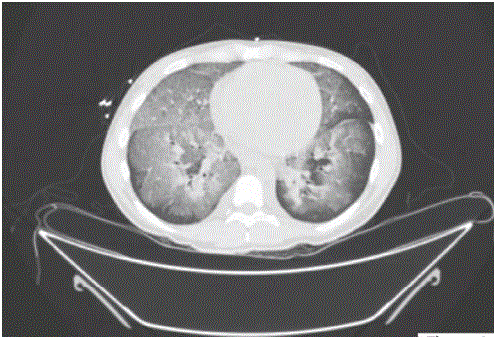
Figure 1: Presents computed axial tomography with a pattern compatible with diffuse alveolar hemorrhage.


Véliz-Escobar José Fidel1 Castor-Hernández Rogelio de Jesús1 González-González Carlos Brando1 Borbolla-Flores Paola1 Guerrero-González Elisa María1 Rizo-Topete Lilia María1 Soto-Abraham María Virgilia2 Olivo-Gutiérrez Mara Cecilia1,*
1University Hospital “Dr. José Eleuterio González”, Nephrology Service, Monterrey, México*Corresponding author: Olivo-Gutiérrez Mara Cecilia, University Hospital “Dr. José Eleuterio González”, Nephrology Service, Monterrey, México, Email: [email protected]
IgA nephropathy (IgAN) is the most common form of primary glomerulonephritis worldwide. Although it is usually confined to the kidneys, diffuse alveolar hemorrhage (DAH) as the first symptom is very rare, leading to an atypical Pulmonary-renal syndrome with negative immunological markers. We present the case of a 16-year-old female patient who was admitted with hemoptysis, dyspnea, and severe acute kidney injury (eGFR 2.3 mL/ min/1.73 m² and creatinine 19.6 mg/dL). Tests confirmed DAH and ruled out anti-GBM disease or ANCA vasculitis. Five sessions of plasmapheresis were performed to address the clinical suspicion, which stopped the pulmonary hemorrhage. However, the renal biopsy showed IgAN with fibrocellular crescents and advanced interstitial fibrosis (more than 50%), resulting in a lack of subsequent recovery of renal function. This case highlights that aggressive treatment with plasmapheresis is vital for pulmonary survival in the face of this unusual extrarenal manifestation; however, if there is severe chronic structural damage, the long-term renal prognosis remains guarded.
IgA nephropathy; Diffuse alveolar hemorrhage; Pulmonary-renal syndrome; Plasmapheresis; Acute kidney injury
IgA nephropathy (IgAN) is the most common cause of primary glomerulonephritis in most developing countries. Most cases of IgAN are clinically restricted to the kidney, however diffuse alveolar hemorrhage as initial presentation is extremely rare but possible. Pulmonary-renal syndrome involving a combination of alveolar hemorrhage and rapidly progressive glomerulonephritis is the typical presentation of ANCA-positive vasculitis, but some other rare causes may present it as well, such as ANCA-negative vasculitis (e.g. IgAN). We present a case report of alveolar hemorrhage as initial presentation of IgAN [1-3].
A 16 y-o, female, with no prior medical history. She started 5 days earlier with dyspnea and hemoptysis, receiving outpatient antibiotic therapy without improvement. She came to the emergency room with cough, dyspnea, and bloody expectoration, having tomographic findings compatible with diffuse alveolar hemorrhage (DAH) (Figure 1). Key laboratories included SCr 19.6 mg/dl, GFR 2.3 ml/min/1.73m2 (CKD-EPI), BUN 160 mg/dl, Na 138 mmol/L, K 7 mmol/L, C3 106 mg/dl, C4 24.1 mg/dl, Anti-MBG negative, Anti-DNA negative, P-ANCA negative, C-ANCA negative, urinalysis shows 30 erythrocytes per field and proteins 30mg/dl, and blood gas analysis with elevated anion gap metabolic acidosis. Due to suspicion of vasculitis, plasma exchange was prescribed and performed with a total plasma volume of 1797ml and 5 exchanges and the hemorrhage remitted. Renal biopsy showed IgA nephropathy with fibrocellular crescents, interstitial fibrosis grade III (>50%), tubulointerstitial nephritis and chronic arteriopathy (Figures 2, 3). Patient showed no improvement on kidney function and was transferred to peritoneal dialysis as chronic therapy. The plan will subsequently involve a kidney transplant protocol and the procedure will be performed as soon as possible, remembering that this is the definitive renal replacement therapy, especially in a patient as young as the one in the presented clinical case.
Figure 1: Presents computed axial tomography with a pattern compatible with diffuse alveolar hemorrhage.
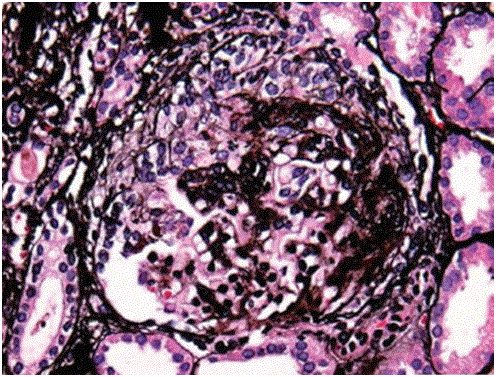
Figure 2: Presents a section stained with Jones methamine silver stain identifying a glomerulus with a fibrocellular crescent.
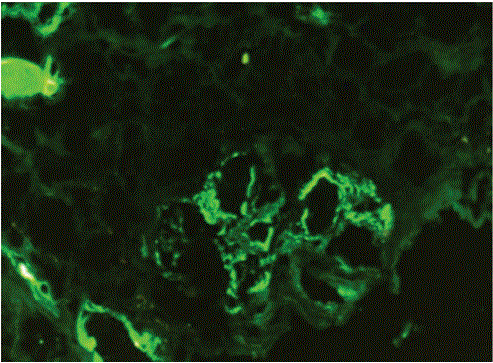
Figure 3: Presents direct immunofluorescence in frozen tissue with a positive finding for IgA with a global and diffuse granular pattern in the mesangium (2+).
IgAN has a variety of renal and extrarenal manifestations. We presented a case of a female patient with IgAN and DAH, evidence regarding this combination is scarce. Simultaneous and sequential involvement have been described and kidney biopsy patterns include crescentic glomerulonephritis (GN), mesangio-proliferative GN, membranous GN and fibrillary GN [1-3]. Treatment with systemic steroids, immunosuppression and plasma exchange have been used in similar cases.
Download Provisional PDF Here
Article Type: CASE REPORT
Citation: Escobar José Fidel V, de Jesús CHR, Carlos Brando GG, Paola BF, Elisa María GG, et al. (2026) Diffuse Alveolar Hemorrhage as an Atypical Presentation for IgA Nephropathy: Case Report. J Clin Case Stu 11(3): dx.doi.org/10.16966/2471-4925.290
Copyright: © 2026 Escobar José Fidel V, et al. This is an open-access article distributed under the terms of the Creative Commons Attribution License, which permits unrestricted use, distribution, and reproduction in any medium, provided the original author and source are credited.
Publication history:
All Sci Forschen Journals are Open Access